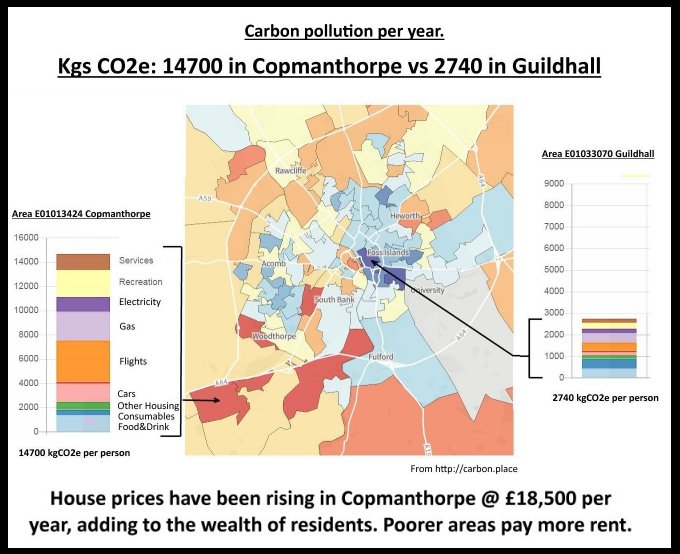
Over recent decades, large increases in property prices have given considerable wealth to house owners. Many of these are affluent people in affluent areas. The less affluent in less affluent areas are paying more rent.
If the World were like York people we’d need three Earths
A recent report compiled by John Barratt of the Stockholm Institute for Planet York says that an average York resident has an individual green footprint of 6.91 hectares. This report gives a “fair earthshare” footprint as 2.1 hectares so if everybody on Earth lived as the residents of York, we would need three planets like Earth.
Quick Action Needed!! Is it time for a Green or Graded Basic Income (GBI)?
Graded Basic Income is Green
The Graduated Basic Income (GBI) is a new idea which builds on proposals for a Universal Basic Income (UBI). However, unlike the UBI, the GBI is quick to implement, avoids some of the objections against UBI, and is especially fit for these troubled times of extreme price rises. The GBI is also Green, because it does not incentivise the increased use of energy. In this is differs from proposals such as tax cuts, fuel rebates and special social tariffs which are designed to bring down fuel prices and thereby incentivise their use and over-use.
York Council strategies show little care for inequality or the climate crisis.
Climate change and inequality
Would Greta say York Council is lying?
In A Net Zero Carbon Roadmap for York, Professor Gouldson estimated York’s share of the remaining carbon budget for 1.5°C. It was 50 tonnes CO2e per citizen from the beginning of 2020.
The remaining carbon budget is the amount of greenhouse gases, that humanity can emit while still having a chance to contain global warming within 1.5°C compared with pre-industrial levels, as advocated by the Paris Agreement.
Flying is one of the most carbon intensive activities: More CO2 emitted for every pound spent.
Carbon intensity
As noted in the previous post, Green Growth or Degrowth, carbon intensity is a measure of the amount of CO2 emitted (in grams CO2) for each unit of economic output (e.g. in £). Worldwide it’s presently over 500 grams CO2 for every £ of economic output produced.
Activities with high carbon intensities
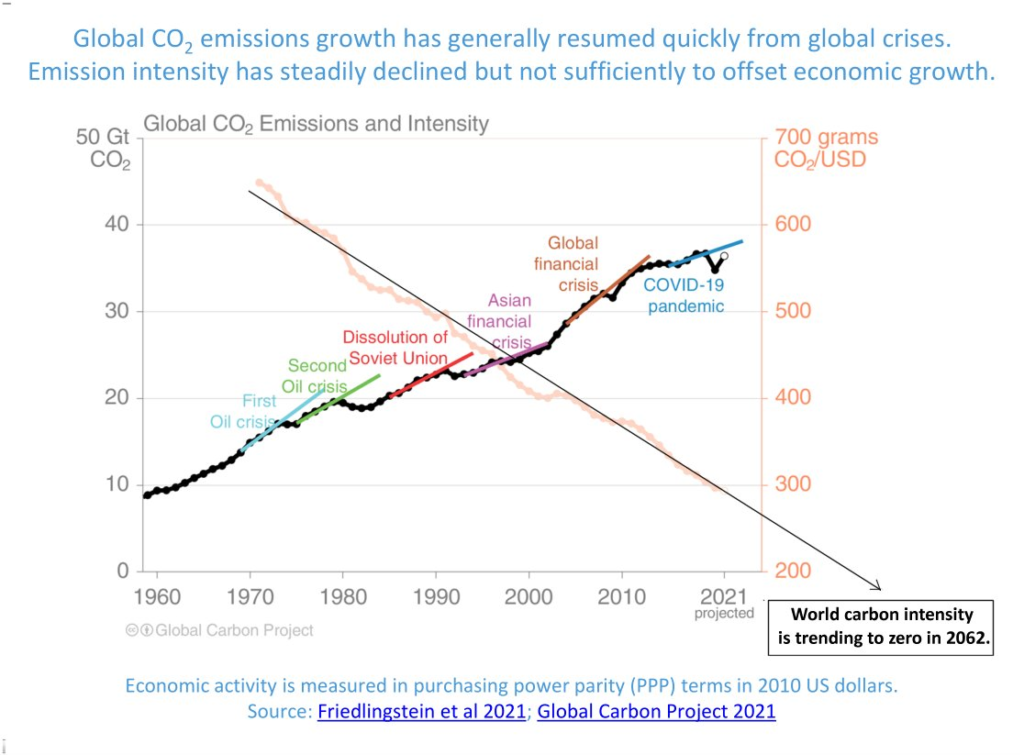
For 50 years or more carbon intensity has declined: For a given amount of economic output (Gross Domestic Product or GDP) there has been less CO2 emitted. This has been a steady downward trend. Doubling the rate of decline only allows a very small increase in GDP – if emissions are to keep within carbon budgets.
This post sets aside the concerns of the previous post, Net-zero is not good enough. This post discusses strategies to get to net-zero – the time when residual emissions of greenhouse gases are balanced by their removal. It relies on two excerpts from the Global Carbon Project 2021– plus an estimate of future economic growth from the International Monetary Fund.
Figure 1 from the Global Carbon Budget 2022, with annotation.
Carbon intensity
The link between greenhouse gas emissions and economic activity (GDP) is strong: The greater GDP, the greater the emissions of greenhouse gases.
There is a simple factor, which helps understanding of this relationship. It is the carbon intensity of economic output, a measure of the amount of CO2 emitted (in grams CO2) for every unit of economic output (e.g. in £). Worldwide it’s presently over 500 grams CO2 for every £ of economic output produced.

 rss feed